QR Codes on Gravestones: How It Works
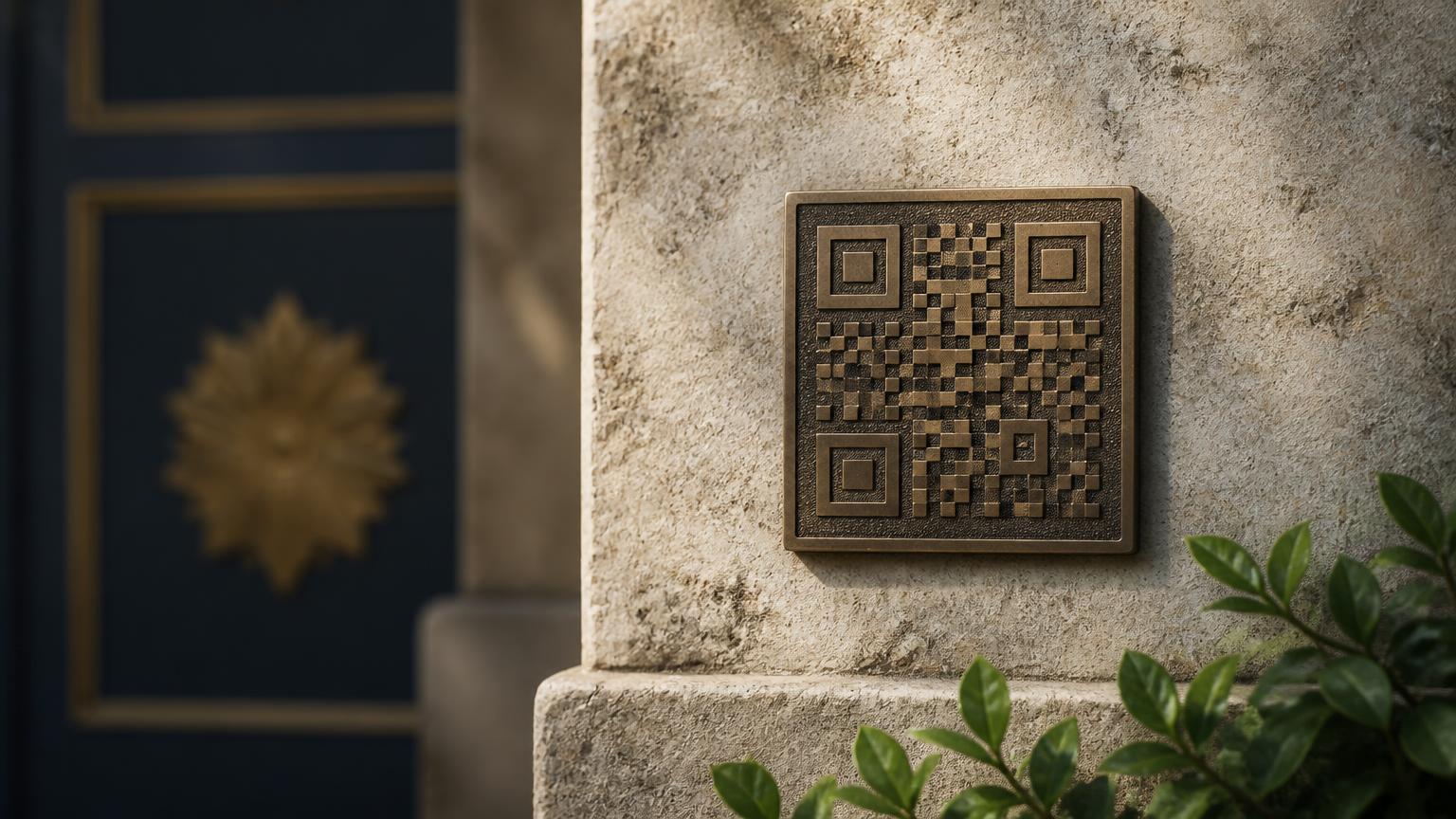
A headstone can hold a name, two dates, and perhaps a line of text. A small scannable plaque beside it can hold everything else. This article explains what a QR memorial plaque is, how it is made and mounted, what it actually costs, and what to check with the cemetery before you have one made.
What a QR memorial plaque is
It is a small metal plate carrying a printed or engraved code. A visitor points a phone camera at it — no app, nothing to install — and the phone opens a digital memorial page for the person: their photograph, an account of their life, and the memories their family and friends have gathered there.
The plaque itself contains no personal information and no data. It is a pointer, nothing more. What it points to is the memorial page, and that page can be edited, added to, and expanded for as long as it exists, without the plaque ever changing. A photograph found in 2031 can be on the page the same evening; the stone stays as it is.
How it works in practice
The sequence is short. You create the memorial page first — see What Is a Digital Memorial Page if you have not yet — and the code is then generated for that page automatically, ready to download in a second or two.
The page is free to create, and so is the code. One button produces a complete download package: a vector file for engraving, high-resolution images, a print-ready PDF in three standard sizes, and a short specification sheet in your language. There is no subscription, no purchase and no expiry date — the link keeps working for as long as the page exists, within generous fair-use limits on photographs and storage that a family memorial will not come near. From a Graveside to a Whole Life explains the free code in more detail.
The code is yours. You take the files to whoever you trust with the stone — a stonemason, a sign maker, an engraver, or the funeral home — and they produce the physical object. You are never tied to one supplier, and nothing about the code stops working if you change your mind about the plaque.
Materials and durability
A plaque on a grave is outdoors permanently, in frost, sun, salt air and rain. The material is the whole question.
Three materials are standard for outdoor memorial hardware: anodised aluminium, bronze or brass, and laser-engraved stainless steel. All three are used precisely because they tolerate weather over long periods without the code degrading to the point where a camera cannot read it. Bronze and brass develop a patina over years, which some families want and others do not — worth thinking about, because it is a deliberate aesthetic choice rather than a fault.
If you have the code engraved into the stone itself instead, discuss legibility with the engraver. A scannable code needs contrast and clean edges; engraved into dark polished granite it can work well, but into rough or pale stone it may not scan reliably. Ask to test one with a phone before it goes on the memorial.
Sizes and what fits on a stone
Plaques come in small formats — roughly the size of a coin up to around the size of a coaster. Larger is easier to scan from a distance and easier for older visitors with less steady hands; smaller is less visually intrusive on a stone that was designed without it.
Most families choose the smallest size that scans comfortably from arm's length, and place it low on the stone or on the base rather than near the name. The download package includes three print-ready sizes, so you can print the code on paper, tape it to something at the height of the stone, and try scanning from where a visitor would stand before anything is made in metal.
Mounting: easier than you think
This is a small job, not a building project. A light aluminium plaque goes on with outdoor adhesive or heavy-duty double-sided mounting tape — the same products used for house numbers and name plates. Clean the surface, press the plaque on, and you are done in a few minutes. Nothing is drilled, nothing is cut, and if you ever change your mind it comes off again.
If the stone has not been made yet, you have an even simpler option: ask the stonemason to engrave the code straight into it. Many families think that looks best, and it costs very little extra while the stone is being cut anyway. A ready-made plaque next to the inscription looks just as good and is quicker.
You can also keep the stone untouched and put the plaque on the base, on the surround, or on a small marker beside the grave. It is your memorial — pick the version you find most beautiful.
A word on cemetery rules
In most places a small, discreet plaque is simply not an issue — a coin-sized plate on your own family stone raises no eyebrows. If you happen to know that your cemetery has particular preferences about size or materials, it is worth a glance at them, but this is not something to lose sleep over or to let delay the memorial page.
Rules differ from place to place, so we make no claim here about any country's regulations. And if you would rather not touch the stone at all, a plaque on the base or on a small marker beside the grave sidesteps the question entirely.
The fastest version: print it today
You do not have to wait for metal at all. The download package includes a print-ready PDF, so you can print the code on ordinary paper, laminate it if you want it to survive the weather, and have it in place the same day.
That is often exactly what families do for the funeral itself: the code on the order of service, on a card beside the guest book, or on a small laminated sign among the flowers, so everyone present can see the photographs and add a memory that same afternoon. The same works at a roadside or an accident site, where something needs to be up within hours.
The paper version and the engraved version point to exactly the same page. Print now, decide about the plaque later.
What it costs
Less than most people expect, because the digital half is free.
The memorial page costs nothing. The QR code costs nothing, and the download package with the engraving files costs nothing. There is no subscription behind the code and no fee to keep it working — nothing lapses, and nothing stops resolving because a payment was missed years from now.
The only cost is the physical object, and that money goes to whoever makes it: the stonemason who cuts the code into the granite, or the sign maker who produces a small metal plate. Prices vary enormously by country, material and size, so ask two local suppliers for a quote. Direct engraving into an existing stone is often the cheapest route, and a small aluminium plate is usually cheaper than bronze or steel.
Getting it made
Because the files are made to professional standards — vector for engraving, high-resolution raster, print-ready PDF — any competent craftsman can work from them without asking you for anything else. That means the practical route is local, wherever you are in the world: no shipping, no import charges, no waiting on a delivery from another country, and someone you can talk to face to face about how it should look on the stone.
If you are unsure who to approach, the monument firm that supplied or engraved the headstone is the natural first call. Funeral homes will usually know who does this work locally as well.
Is it worth it?
The code itself costs nothing, so the question is really about the plaque.
Honestly: for some graves, no. A plaque adds an object to a memorial that a family may have chosen carefully, and if nobody in the family is likely to maintain the page behind it, the plaque points at nothing.
Where it earns its place is where there are people who will keep adding — a family that gathers photographs, a grandchild who will one day want to know who this person was, a wide circle of people spread across countries who cannot visit but can read. In those cases the plaque does something a stone cannot: it lets the memorial keep growing after the carving is finished.
And because the page and the code are free, there is nothing lost in making the page first and deciding about the plaque later. If you are working through everything that has to be arranged in the first weeks, When Someone Dies: A Practical Checklist may be more useful to read first. A plaque is not urgent, and it is easier to decide well later.